Wednesday, February 26, 2014

A Way for Students to Recognize and Spell Their Name


Hello teacher pals!

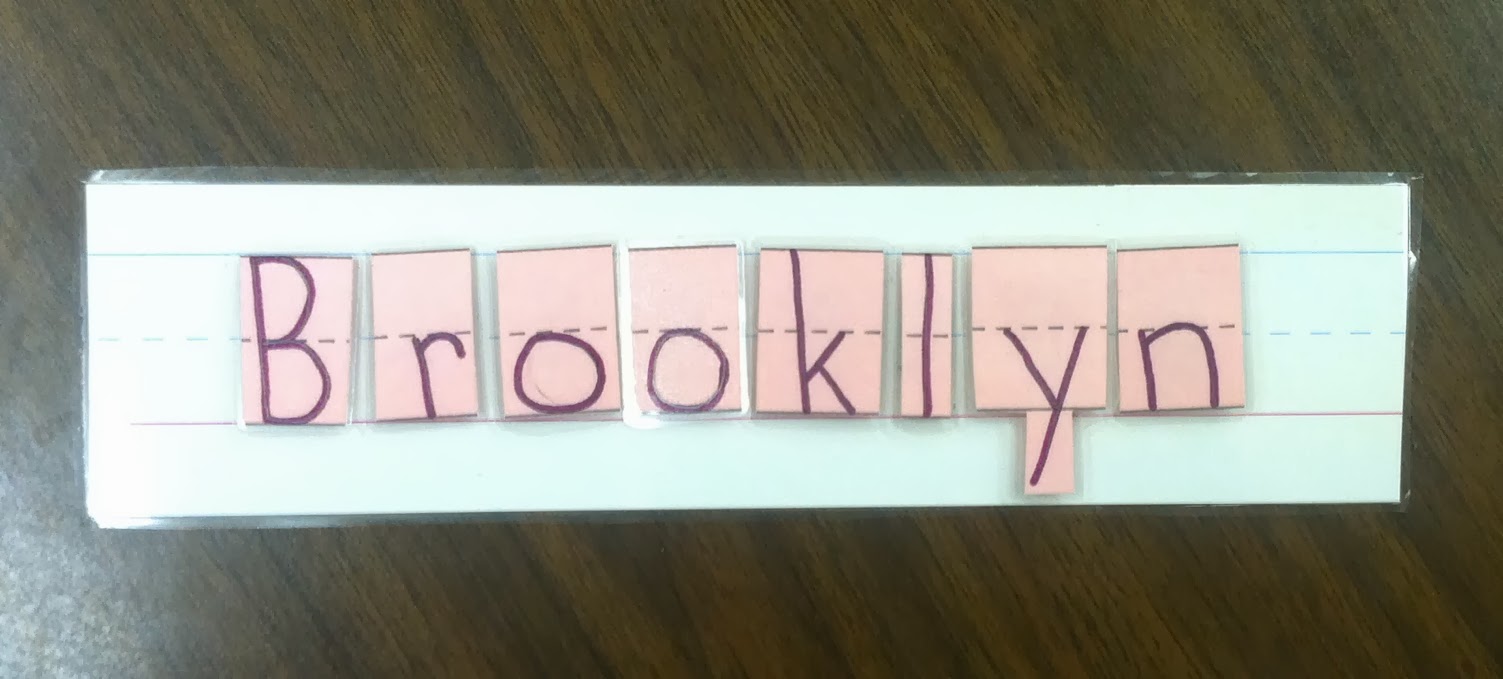
I hope everyone is having a fabulous week so far! Today is hump day, so it's downhill from here! Today, I want to blog about a way for students to practice recognizing and spelling their name, especially if they have fine motor challenges. I have a student that really struggles with handwriting. She is also still working on learning all of her letters and sounds. I would really like for her to be able to recognize her name and hopefully form the letters in her name. Obviously, writing her name is a great way to practice! I still wanted something that she could work on that had her focus on spelling her name without worrying about forming the letters. Pictures are below to show what we are going to try.


I cut a sentence strip and laminated it. Then, I wrote the name on a colored sentence strip with a pencil. I traced over the pencil writing with a marker. I cut those out and laminated them. Last, I stuck the rough side of the Velcro to the sentence strip and the soft side of the Velcro to the letters. She likes hands-on things, so hopefully this will help! In what ways do you help your students learn to recognize and spell their name? 


Don't forget to check out the 3 Million Teachers Strong Sale! With the promo code TPT3, you can get everything in my store for 28% off. Check out my new item, "The Happy Caterpillar Counting Book". It would make a great companion item to any unit based on "The Very Hungry Caterpillar"! 


Tuesday, February 4, 2014

Alternative Algorithms for Multiplication


Common Core standard 4.NBT.5 reads as follows:

“Multiply a whole number of up to four digits by a one-digit whole number, and multiply two two-digit numbers, using strategies based on place value and the properties of operations. Illustrate and explain the calculation by using equations, rectangular arrays, and/or area models.”

Many of us are quick to jump right into the traditional algorithm that we learned as 4th grade students. It is an efficient strategy. The problem, however, is that our students end up memorizing efficient steps instead of understanding the “whys” behind “what” they’re doing.  Essentially, we’ve been teaching multiplication backwards.

Students need time with other methods of multiplication before we introduce the “shortcut” algorithm we know and use. They need lots and lots of hands on time! Research says that students could need as much as two years of conceptual practice with multiplication before we introduce the algorithm. This might be why the words “standard algorithm” for multiplication isn’t mentioned in the CCSS until 5th grade (5.NBT.5 Fluently multiply multi-digit whole numbers using the standard
Algorithm).

So how do teachers teach multiplication if we aren’t using the algorithm?

Let’s start the way any good lesson might begin- with the use of manipulatives. Most students have used the base ten blocks in the early grades, so it’s a nice way explore multiplication.  Let’s take the example of 24 x 6.


To use base ten blocks, we’ll multiply 20 x 6 and 4 x 6. The partial products will be listed as base ten blocks.


 From here, students should add the partial products together to find the total product, 144. I like this method because I can visually see and touch the product.


This method transitions well into my next suggestion. Once we get the idea of how to use an area model of multiplication, we can replace the base ten blocks with numbers.

I like this method because it’s a nice reference to the area of a rectangle too. When we add up the area of the smaller rectangle and add it together, we find the area of the larger rectangle.


I’d also like to suggest that you try teaching multiplication based on partial products and place value. Place value is again one of those topics that the early grades really emphasize, so it seems natural to use their understanding of place value to multiply.

Let’s use 245 x 6.

    245
     x  6
       30     6 x 5
+   240    6 x 40
   1200    6 x 200
   1470

The great thing about this method is that students really begin to see that they’re multiplying 6 times each place value- the hundreds, tens, and ones. As a matter of fact, they can multiply ANY place value first and get the same product!

Students need a lot of time to explore multiplication through various representations before they’ll understand the standard algorithm. Yes, they might be able to memorize the steps, but wouldn’t you want their understanding of multiplication to go a bit farther?  You don’t have to teach every alternative algorithm out there. Students don’t need to master every alternative algorithm either. You know your students and their learning styles, so focus on strategies that best fit your students. Allow them to find a few methods that they enjoy and go from there.

Looking for a few resources on the area model of multiplication? Check out my Multiplication Round-Ups!


These cowboy themed seat scoots focus on multiplying a 2 digit number by a 1 digit number and 3 digit by 1 digit using the area model method. Students will find partial products and add them together to find the product of various multiplication problems. But watch out! Some cards have missing factors as well!


Want more math ideas? Remember to follow Totally Sweet Math Centers by Tabitha on Facebook! 


Sunday, January 26, 2014

Parent-teacher communication-Juliana

Have you ever made a mistake on something you have sent home? 
How do you handle it?


I work with two very special teachers in my kindergarten team. One of them is Ms. K.
Ms. K is simply amazing. She is efficient, effective, fast, always positive, and thoughtful. She is also a really hard worker and goes above and beyond for her students and activities.Last week, she received a "not so nice" note from a parent.
The parent found a typo on an assignment, specifically an extra “k” on the word “than”. The parent wrote “I find it very difficult to teach my kid when you send stuff like this
        Mrs. K., who like most of us, works 10-12 hours per day, does not have an assistant to proofread all of the papers that are sent home, and that creates her own activities, was very disappointed when she read the note. She was also upset for making a mistake, since she tries really hard not to be careless. Her approach to the situation was remarkable, and something I would not have thought of as my first option. She addressed the situation by calling the parent right away. As she talked to the parent:
1.     Her tone of voice was really calm and relaxed.
2.    She greeted the parent nicely and said “I am calling you because I received your note”
3.    She thanked the parent for correcting her error.
4.    She let her know that when she makes a mistake in class she uses it as a teachable moment.
5.    At the end of the conversation, she told her that this was not going to be the last time she makes any mistakes.


What was the parent reaction?She said her daughter and her family appreciate everything that she does for her child. She said she was tired when she wrote the note because it was really late and they were doing homework.


When we make mistakes in class, we have to show our kids that we all make them. Let’s not go to the extreme of being careless or extremely anxious for making them, let’s learn from our mistakes and turn them into a teachable moment. Let's all learn that it is okay! Maybe that way, when our students become parents, they will approach the same situation differently.

Monday, January 20, 2014

Personal Space: Teaching Boundaries & Free Diagram


Special needs children may struggle to maintain personal space when talking to others or when they are upset. The student may stand too close to another person or even grab at them when they are talking. The student may take things that they want without asking. Also, physical aggression may be shown when a child does not know how to communicate his/her frustration or anger. Fortunately, special needs children can learn about and maintain personal space through books/discussions, fun exercises, and hands-on activities. 

It is important to lead discussions about personal space. A teacher can do this by simply talking about different scenarios, by acting them out with assistants, or by reading a book. It's important to let students know that it can be scary when we invade each other's personal space. It can make it hard to make friends, and it can get them into trouble for breaking classroom rules. 

After talking about personal space, it is important to follow-up with an exercise or activity. Diagrams are a nice way to show which physical boundaries are appropriate. It gives the student a concrete image of what is appropriate and what is not appropriate. Another fun activity is to have the student stand in an open area. Have them put their arms straight out and spin around in a circle. It gives them a feel for their own personal space. 

I'd love to hear your ideas on this topic!!  

Click here for your diagram freebie!