Monday, April 7, 2014

Stitch Fix Review and Giveaway

I am not a huge shopper.  I like looking at fun styles, but dislike going to malls and trying things on.  I also do not invest a lot of money in clothes.  The majority of my clothing was bought at consignment stores.  I used to travel quite a bit and liked being able to carry all of the clothing I needed for a few months in a backpack.

 However, I now need to look professional.  I have been wearing the same outfits to school every day and would like a few new pieces.  I decided to try STITCH FIX, which is a service that sends you 5 items that a stylist chose for you.  These picks are all based on a style profile that you fill out telling what kind of styles you like and what your body type is like.  The stylists can even take a peek at your Pinterest boards to get a feel for your style. 

Then, they send the clothing pieces directly to your house, you try them on and decide what to keep (if anything) and then you send back what you don't want. Easy peasy.

The details:
* There's a $20 styling fee, which you can use toward your order. (that's awesome!!)
*  If you keep all 5 items you receive 25% off your order.
* You choose your price range
* The more feedback you give on the pieces sent to you, the better they get over time. So be sure to be very specific to your stylists so that they can send you things you'll love.

I specifically told them that I would like pieces that can transition from professional wear in the classroom to good items for date nights during the weekends.   

One thing I really like is that they send you these "Style Cards."  To the left, you will see the style cards for 4 out of 5 of my items (everything but the necklace). 


Ready for the fashion show?  Here goes!  I may need some tips on how to take selfies... the angles were a little awkward for me!

 To the left, you will see the stack of clothing that I received.  So exciting!


Item #1 is this 3/4 sleeve cardigan.  I really loved the color and it seemed to be a high quality item.  It fit well, and I had been thinking that I could use another cardigan or two. 
Verdict : Kept it!


Item #2 is this blue dress.  I liked the color and the fabric was forgiving, but the style felt a little too "old" for me.  Also, the pockets were right on the hips and bulged out a little bit.  I didn't hate it, but couldn't justify keeping it.
Verdict: Sent it back.


Item #3 was this necklace.  It seemed a bit tacky to me, and was the one item that I definitely didn't like.
Verdict: Sent it back.


Item #4  - Skinny Jeans ---
To be honest, I wasn't even planning to try these on when they came in the box.   They were $88, which is way more than I have ever spent on jeans.  As I said before, I usually shop at Plato's Closet.  I had been planning to buy jeans for a while because I only own one pair and they are WORN OUT!

I tried these on and THERE WAS NO GOING BACK!  I loved them!  The fit was perfect on me and they were so comfortable.  I will get some great use out of these.
Verdict: Kept it!


And Item #5 was the magnolia tank that I am wearing in the picture above.  See the tank to the right.  This is not a tank I EVER would have picked out in a store, but I really loved it on.  I emphasized in my style profile that I like my tops a little bit more loose and my bottoms a little bit more fitted due to my body type.  This tank was flattering and I love the fun pattern peeking out!
Verdict: Kept it!


 Overall, I am very happy with my Stitchfix experience!  I kept 3/5 of the items.  It is definitely more than I would normally spend on clothing, but I still think that I will treat myself to a fix a few times a year.  Next time, I want to emphasize that I would like some more fun fabrics and maybe more of a "boho" kind of style.

If you want to check this out for yourself, click here!

 
I am offering a $20.00 giftcard to Stitch Fix to one lucky winner! 

a Rafflecopter giveaway

Saturday, April 5, 2014

My Thoughts on "The Earth and I" by Frank Asch and TPT Item

Hello teacher friends!

I ran across a book a few weeks ago and fell in love with it. It's called "The Earth and I" by Frank Asch. The pictures are beautiful with bold, eye catching colors! I also like the way it refers to the earth as a friend. I think it's a good way to show our students that the earth should be respected and cared for just like our friendships! It's a short and simple story that can be read to your students before they get restless or bored. Since I liked this book so much, I decided to create some worksheets that compliment it. I am looking forward to using them on Earth Day in my classroom! To go check it out click here!


Friday, March 21, 2014

Trade and Grade


Who doesn't need a little extra practice in basic fluency, right? I've got just the product for you! My friend Laura from Differentiation Station created an amazing set of monster themed fluency centers called Monster Munch!
Click here to see Monster Munch on TPT!

This 121 page product contains 4 types of activities- "Roll, Add Cover", "Monster Hop",  "Monster Munch", and "How Many More Cookies Did He Munch?".   Each of the 4 activities comes with alternate variations to meet the needs of all learners!

Roll, Add, Cover

The first set of games in this pack are called "Roll, Add, Cover."  


You'll love all three variations to meet the specific needs of your students: basic addition through sums of 12, adding doubles, and adding three numbers.

For the "2 dice" version, students roll two dice, record the equation on their answer sheets, and cover the sum on their game board. The first to cover their game board wins!


Roll, Add, Cover- Sums through 12


The "doubles" game plays much the same. Students will roll one die, double the number, record the equation, and cover the sum on their game board.


Roll, Add, Cover- Doubles


For the "3 dice" version, students roll three dice, add, record, and cover on their game board.
Roll, Add, Cover- Three Addends
What I love: I love centers that have the same basic rules of play: roll the dice, record, and cover up on your game board. With a slight twist (number of dice, in this case), I've got my students working on a whole new skill!

Monster Hop

The Monster Hop activities introduce addition on a number line. First, create a large number line on the floor. Next, students place the monster numbers in order on the number line.


Monster Wands


Using the "Monster Wand," and anchor chart, students will use the number line to add on to any number. Place the wand at the largest addend and hop forward to find the sum.


Students LOVE the monster wands!

Lesson extensions for the number line Monster Hop are included. Students draw out a number card and demonstrate the addition equation on the number line. All of the other students will demonstrate the equation on there student sized number line.
Monster Wands


What I love: Students are going to LOVE having their own "student sized" number line and monster wand that matches the "life sized" version!


Monster Munch

Monster Munch is a fun little center where students use  cookie manipulatives to represent various addition equations.

Monster Munch Center


At the center, students will choose one of the Monster Mats. Each mat contains an addition equation. There are two sets of mats included: Sums to 10 and sums to 20.  You can choose which level works best for each small group of students.

The cookie counters are provided, but you could easily replace the counters with another object, such as rocks, linking cubes, or fun cookie cereal!

What I love:  Both the sums to 10 and sums to 20 monster mats visually look the same-- students enjoying the same center could be working at an individualized level!


How Many More Cookies Did He Munch?

The last set of activities focuses on finding the missing addends.


How Many More Cookies Did He Munch Center


At this center, the students will choose one Monster Mat. Each mat shows an addend and the sum. Students will place the cookie manipulatives in the missing addends spot and count on to find how many more. This center comes with varying levels as well: Sums of 10, sums to 10, and sums greater than 10.  This center also comes with a student record sheet, where students will record their addition equations.

What I love: Using cookie manipulatives to count count on is a fun, hands-on way for students to practice counting on to find a missing addend!


The teacher information in this product is is clear and easy to follow. Pictures are included for the visual learners! With four different activities and lots of variations, you just can't go wrong by purchasing this product!


Want to sample this product out for yourself? 


Click here to get your sample!


Click here to check it out, or click here to purchase this "Monster" of a resource on TPT!

Want to learn more about Differentiation Station? Follow on Facebook  and TPT!


a Rafflecopter giveaway

Wednesday, February 26, 2014

A Way for Students to Recognize and Spell Their Name


Hello teacher pals!

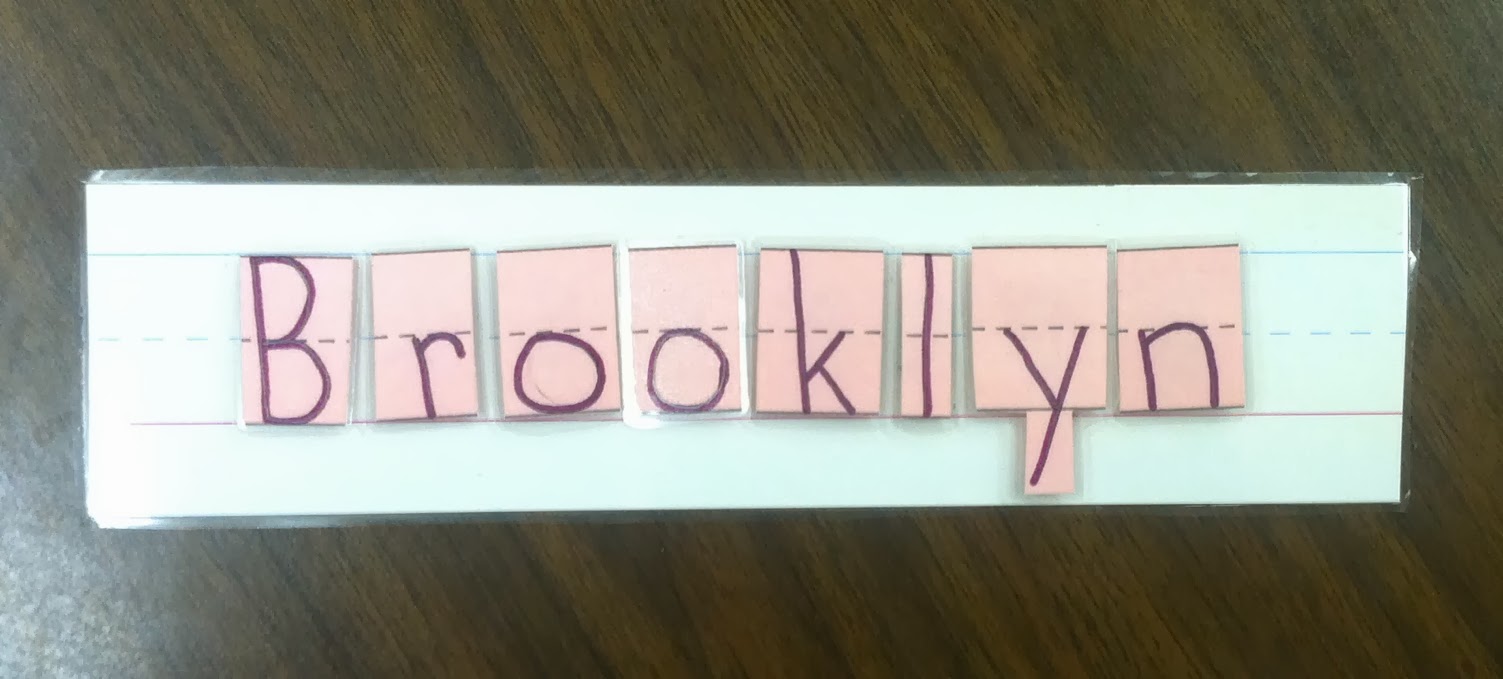
I hope everyone is having a fabulous week so far! Today is hump day, so it's downhill from here! Today, I want to blog about a way for students to practice recognizing and spelling their name, especially if they have fine motor challenges. I have a student that really struggles with handwriting. She is also still working on learning all of her letters and sounds. I would really like for her to be able to recognize her name and hopefully form the letters in her name. Obviously, writing her name is a great way to practice! I still wanted something that she could work on that had her focus on spelling her name without worrying about forming the letters. Pictures are below to show what we are going to try.


I cut a sentence strip and laminated it. Then, I wrote the name on a colored sentence strip with a pencil. I traced over the pencil writing with a marker. I cut those out and laminated them. Last, I stuck the rough side of the Velcro to the sentence strip and the soft side of the Velcro to the letters. She likes hands-on things, so hopefully this will help! In what ways do you help your students learn to recognize and spell their name? 


Don't forget to check out the 3 Million Teachers Strong Sale! With the promo code TPT3, you can get everything in my store for 28% off. Check out my new item, "The Happy Caterpillar Counting Book". It would make a great companion item to any unit based on "The Very Hungry Caterpillar"! 


Tuesday, February 4, 2014

Alternative Algorithms for Multiplication


Common Core standard 4.NBT.5 reads as follows:

“Multiply a whole number of up to four digits by a one-digit whole number, and multiply two two-digit numbers, using strategies based on place value and the properties of operations. Illustrate and explain the calculation by using equations, rectangular arrays, and/or area models.”

Many of us are quick to jump right into the traditional algorithm that we learned as 4th grade students. It is an efficient strategy. The problem, however, is that our students end up memorizing efficient steps instead of understanding the “whys” behind “what” they’re doing.  Essentially, we’ve been teaching multiplication backwards.

Students need time with other methods of multiplication before we introduce the “shortcut” algorithm we know and use. They need lots and lots of hands on time! Research says that students could need as much as two years of conceptual practice with multiplication before we introduce the algorithm. This might be why the words “standard algorithm” for multiplication isn’t mentioned in the CCSS until 5th grade (5.NBT.5 Fluently multiply multi-digit whole numbers using the standard
Algorithm).

So how do teachers teach multiplication if we aren’t using the algorithm?

Let’s start the way any good lesson might begin- with the use of manipulatives. Most students have used the base ten blocks in the early grades, so it’s a nice way explore multiplication.  Let’s take the example of 24 x 6.


To use base ten blocks, we’ll multiply 20 x 6 and 4 x 6. The partial products will be listed as base ten blocks.


 From here, students should add the partial products together to find the total product, 144. I like this method because I can visually see and touch the product.


This method transitions well into my next suggestion. Once we get the idea of how to use an area model of multiplication, we can replace the base ten blocks with numbers.

I like this method because it’s a nice reference to the area of a rectangle too. When we add up the area of the smaller rectangle and add it together, we find the area of the larger rectangle.


I’d also like to suggest that you try teaching multiplication based on partial products and place value. Place value is again one of those topics that the early grades really emphasize, so it seems natural to use their understanding of place value to multiply.

Let’s use 245 x 6.

    245
     x  6
       30     6 x 5
+   240    6 x 40
   1200    6 x 200
   1470

The great thing about this method is that students really begin to see that they’re multiplying 6 times each place value- the hundreds, tens, and ones. As a matter of fact, they can multiply ANY place value first and get the same product!

Students need a lot of time to explore multiplication through various representations before they’ll understand the standard algorithm. Yes, they might be able to memorize the steps, but wouldn’t you want their understanding of multiplication to go a bit farther?  You don’t have to teach every alternative algorithm out there. Students don’t need to master every alternative algorithm either. You know your students and their learning styles, so focus on strategies that best fit your students. Allow them to find a few methods that they enjoy and go from there.

Looking for a few resources on the area model of multiplication? Check out my Multiplication Round-Ups!


These cowboy themed seat scoots focus on multiplying a 2 digit number by a 1 digit number and 3 digit by 1 digit using the area model method. Students will find partial products and add them together to find the product of various multiplication problems. But watch out! Some cards have missing factors as well!


Want more math ideas? Remember to follow Totally Sweet Math Centers by Tabitha on Facebook!